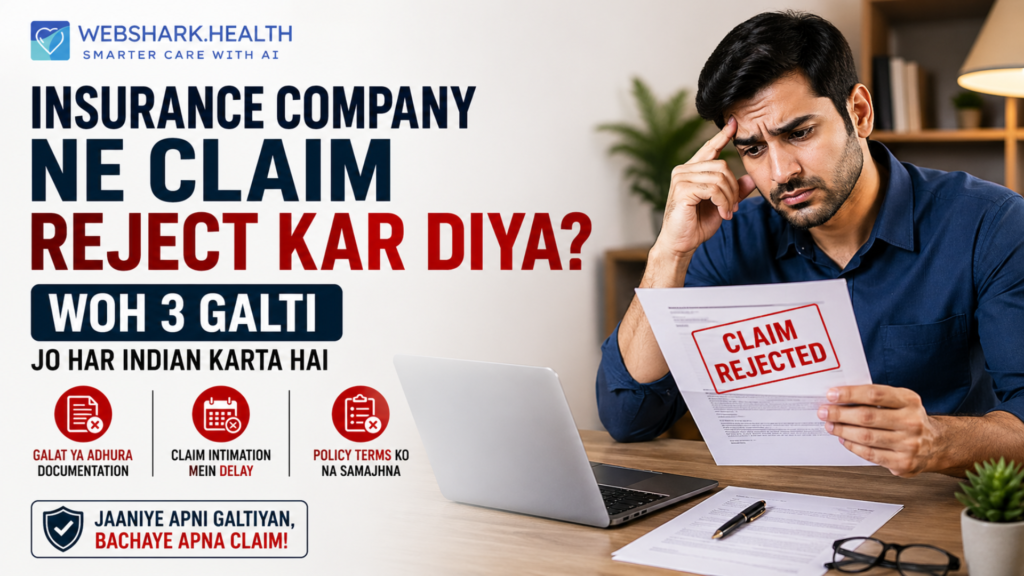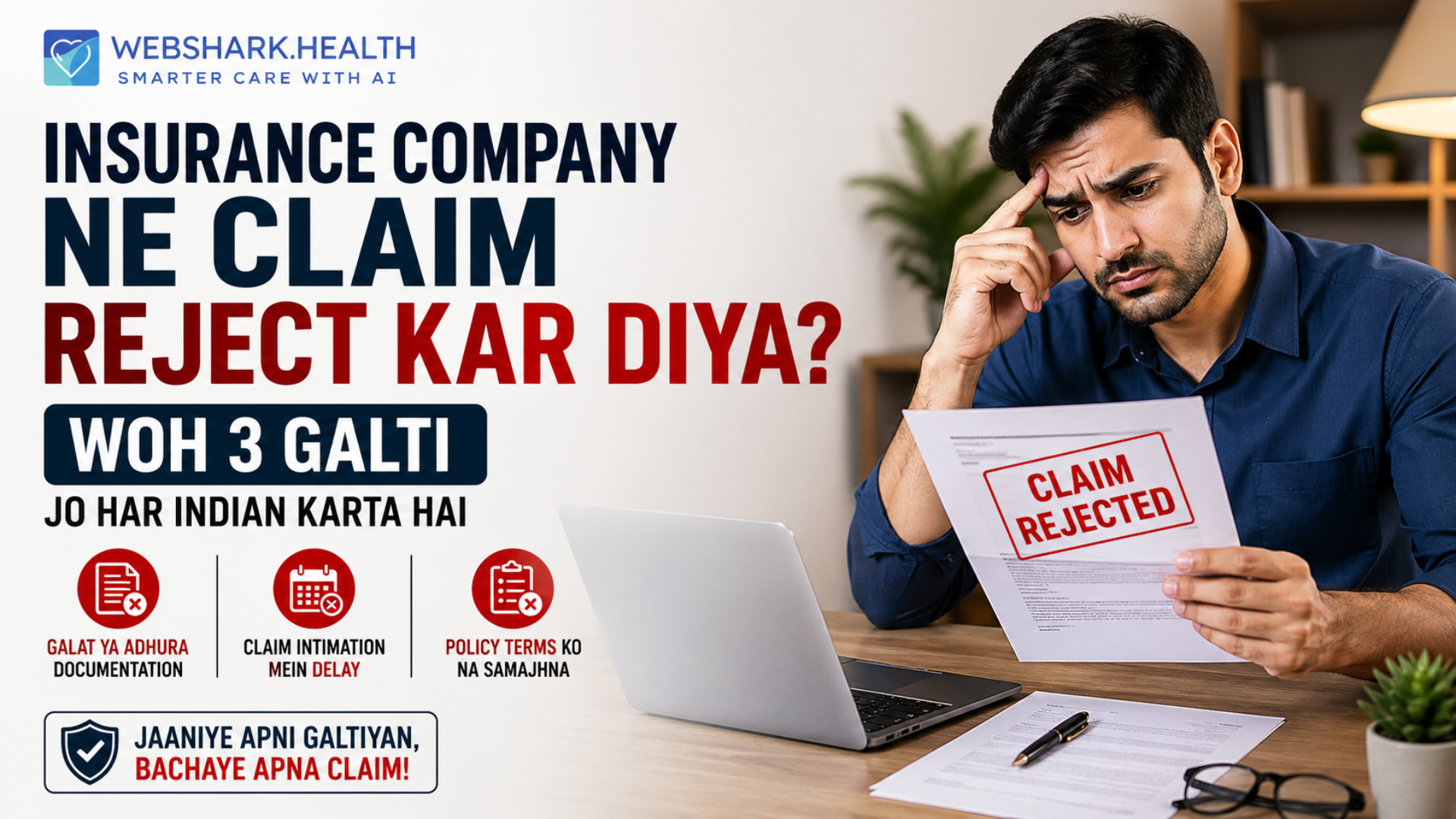

Rajesh Kumar sat in the hospital corridor at 2 AM, his hands trembling as he read the email on his phone for the third time.
“Your claim has been REJECTED due to incomplete documentation.”
His father was in the ICU. The medical bills had already crossed ₹4.5 lakhs. And the health insurance policy he’d been paying ₹18,000 annually for the last 8 years? Worthless.
“Maine toh sab kuch properly kiya tha,” he thought. (I had done everything properly.)
But had he, really?
(Spoiler: This nightmare could’ve been avoided with proper document organization—something Webshark Health’s AI now does automatically. But more on that later.)
The Middle-Class Insurance Trap: Buying Peace of Mind, Getting Sleepless Nights
If you’re reading this, you probably belong to India’s aspiring middle class. You’ve done the responsible thing—bought health insurance, maybe term insurance, perhaps even a vehicle policy. You pay your premiums on time. You feel secure.
But here’s the harsh truth: Over 15% of health insurance claims in India get rejected every year. That’s 1 in every 7 claims—and the rejection rate has been climbing since 2023.
You’re not buying insurance. You’re buying hope that when disaster strikes, someone will have your back.
The problem? Most Indians make 3 critical mistakes that turn that hope into a nightmare when they need it most.
Mistake #1: “Policy Le Li, Ab Tension Khatam” (Bought the Policy, Now All Worries Are Gone)
The Dangerous Assumption
Amit bought a ₹10 lakh health insurance policy in 2022. The agent came to his office, he signed some papers, paid the premium, and filed the documents in his cupboard.
Two years later, his wife needed emergency surgery. The hospital asked for his policy details.
The problem: Amit couldn’t remember which insurance company it was. The policy document was buried somewhere in his cupboard. He didn’t know his policy number. He had no digital copy.
By the time he located the physical document and initiated the claim, the “golden 24-hour window” for cashless claims had passed.
Result: He had to pay ₹2.8 lakhs out of pocket first, then fight for reimbursement for 4 months.
Why This Happens
Indians treat insurance like a “set it and forget it” product. We buy it because:
- Our employer provides it (and we never read the coverage)
- An agent pressured us
- Tax deduction under Section 80D
- “Everyone says you should have it”
But we don’t:
- ✗ Organize the documents properly
- ✗ Store digital copies in accessible locations
- ✗ Review the policy annually
- ✗ Know what’s covered and what’s NOT covered
- ✗ Keep track of multiple policies for different family members
The SEO Truth Nobody Tells You
Search for “health insurance claim rejected India” and you’ll find 2.3 million results. Everyone’s searching for answers after the rejection.
But search for “how to organize insurance documents” or “claim-ready insurance checklist”? Barely any traffic.
We’re reactive, not proactive. And insurance companies know this.
Mistake #2: “Pre-existing Condition Kya Hota Hai?” (What’s a Pre-existing Condition?)
The Fine Print That Destroys Claims
Priya bought health insurance when she was 28 and healthy. At 32, she was diagnosed with diabetes. At 35, she needed hospitalization for a diabetes-related complication.
Claim rejected.
The reason? She had visited a doctor for “high blood sugar” when she was 27—one year before buying the policy. She hadn’t mentioned it in the proposal form because:
- She didn’t think a single doctor’s visit mattered
- She wasn’t officially “diagnosed” back then
- The insurance agent said, “Kuch nahi hota, sign kar do” (Nothing happens, just sign it)
The Pre-Existing Condition Trap
Did you know?
- Any medical condition you had in the 48 months before buying insurance can be considered pre-existing
- Even if you didn’t know you had it
- Even if it wasn’t diagnosed
- Even if you took no medication for it
Common pre-existing conditions Indians forget to declare:
- ✗ High blood pressure (BP thoda high rehta tha)
- ✗ Diabetes (sugar kabhi-kabhi badh jati thi)
- ✗ Thyroid issues (thyroid ki medicine le rahe the)
- ✗ Joint pains (arthritis ki shuruat)
- ✗ Gastric problems (acidity ki regular tablets)
Insurance companies have access to your medical history. They will investigate. And one inconsistency = claim rejection.
The Waiting Period Nobody Reads
Even declared pre-existing conditions have 2-4 year waiting periods. If you claim during this time? Rejected.
Most Indians don’t even know their waiting periods have expired or which specific diseases are still under observation.
Mistake #3: “Document Toh Hai, Claim Ho Jayega” (We Have Documents, Claim Will Be Approved)
The Incomplete Documentation Disaster
This is where Rajesh (from our opening story) went wrong.
He had the policy document. But when the claim assessor asked for:
- ✗ Original medical bills (he had photocopies)
- ✗ Discharge summary with doctor’s signature (unsigned copy)
- ✗ Diagnostic reports from before admission (lost)
- ✗ Pharmacy bills with proper GST invoices (cash bills without GST)
- ✗ Referral letter from primary physician (never obtained)
4 out of 5 documents were “incomplete” according to insurance standards.
The Documentation Checklist Nobody Follows
For a successful health insurance claim, you typically need:
Before Admission:
- Policy document with active status proof
- Photo ID and address proof
- Pre-authorization form (for cashless)
- Doctor’s referral letter recommending hospitalization
- Previous medical records related to current condition
During Hospitalization: 6. All original bills (OPD, IPD, ICU, room, nursing) 7. Itemized bill with medicine names and quantities 8. Discharge summary card 9. All diagnostic reports (X-rays, MRI, blood tests) 10. Doctor’s prescriptions before and after treatment 11. Pharmacy bills with GST invoices 12. Implant stickers/batch numbers (if applicable)
After Discharge: 13. Duly filled claim form 14. Cancelled cheque for reimbursement 15. Any additional documents requested by TPA
Miss even ONE document? Claim processing gets delayed or rejected.
The Digital Age Problem
Most Indian hospitals still operate on paper. You get:
- Handwritten prescriptions (illegible)
- Thermal paper bills (fade within months)
- Loose diagnostic reports (easy to lose)
- Physical discharge cards (stored in random drawers)
When you need to file a claim 6 months later, good luck finding everything in pristine condition.
(This is exactly why Webshark Health was built—to digitize, organize, and preserve your medical documents before they fade, tear, or disappear.)
The Hidden 4th Mistake: “Company Toh Khud Dekh Legi” (The Company Will Figure It Out)
Why Insurance Companies WANT You To Make Mistakes
Let’s talk about something uncomfortable.
Insurance companies are businesses. Their profit model is simple:
- Collect premiums from lakhs of people
- Reject or delay as many claims as legally possible
- Profit from the difference
The average claim settlement ratio in India is around 85-90%. That means 10-15% of claims are rejected—often on technicalities.
Common rejection reasons:
- Non-disclosure – You “forgot” to mention something (30% of rejections)
- Incomplete documents – Missing 1 out of 20 papers (25% of rejections)
- Treatment not covered – Clause buried in page 47 of policy (20% of rejections)
- Waiting period – Claimed too early (15% of rejections)
- Claim amount exceeded – Room rent, specific treatments capped (10% of rejections)
Insurance companies bank on your ignorance, disorganization, and panic during emergencies.
 Chat on WhatsApp
 Get the App
How To Make Your Insurance “Claim-Ready” TODAY (With or Without Webshark Health)
The manual way vs. the smart way—you choose.
Step 1: Organize All Your Policies In One Place (Digital + Physical)
What you need:
- Scanned copies of all insurance policies (health, life, vehicle, home)
- Policy numbers, company names, premium due dates in a spreadsheet
- Nominee details and emergency contact numbers
- Digital storage that your family can access in emergencies
Pro tip: Create a folder structure like this:
Family_Insurance/
├── Health_Insurance/
│ ├── Self_PolicyDoc.pdf
│ ├── Spouse_PolicyDoc.pdf
│ └── Parents_PolicyDoc.pdf
├── Life_Insurance/
├── Vehicle_Insurance/
└── Emergency_Contacts.txt
Alternatively, upload everything to Webshark Health once and let their AI organize it automatically—saving you hours of manual work.
Step 2: Create a Medical History File For Each Family Member
Document everything:
- Annual health checkup reports (last 4 years)
- Ongoing medications and prescriptions
- Previous hospitalizations and treatments
- Vaccination records
- Pre-existing conditions with diagnosis dates
- Family medical history (for genetic conditions)
Update quarterly, not during emergencies.
Smart alternative: Webshark Health automatically creates and maintains digital medical history profiles for each family member—no manual updates needed.
Step 3: Know Your Policy Inside-Out
Read the actual policy document, not the sales brochure.
Ask yourself:
- ✓ What’s covered? What’s NOT covered?
- ✓ What’s the room rent limit? (Most plans cap at 1% of sum insured)
- ✓ Which hospitals are in the network? (For cashless claims)
- ✓ What’s the co-payment percentage, if any?
- ✓ Are maternity, dental, or alternative treatments covered?
- ✓ What’s the claim filing deadline? (Usually 30-90 days post-discharge)
Set a calendar reminder every 6 months to review this.
Step 4: Prepare Your “Emergency Claim Kit”
Physical folder + digital backup with:
- ✓ All policy documents
- ✓ Photo ID proofs (Aadhaar, PAN, Driving License)
- ✓ Address proofs
- ✓ Bank details (cancelled cheque)
- ✓ Pre-filled claim forms (downloadable from insurer website)
- ✓ List of network hospitals
- ✓ Insurance company’s 24/7 helpline numbers
- ✓ TPA (Third Party Administrator) contact details
Keep this in an accessible location your family knows about.
Even better: Store digital copies on Webshark Health where your entire family can access them instantly from any device during emergencies—no searching through cupboards at 2 AM.
Step 5: Document Medical Events IN REAL-TIME
During doctor visits:
- Click photos of prescriptions immediately
- Save diagnostic reports as PDFs
- Keep medicine purchase bills with GST
During hospitalization:
- Request digital copies of all documents
- Photograph physical bills before they fade
- Keep running notes of treatments, dates, doctor names
Don’t wait for the claim to start collecting evidence.
The Tech Solution: Let AI Do The Heavy Lifting (Meet Webshark Health)
Here’s the reality: Most Indians are too busy to implement all of the above perfectly.
You’re juggling:
- Work deadlines
- Family responsibilities
- Kids’ education
- Aging parents
- EMIs and expenses
Who has time to become an insurance documentation expert?
This is where technology becomes your unfair advantage.
Is Your Policy Document “Claim-Ready”? Let AI Check For You
Imagine if you could:
- Upload all your insurance documents to one secure place
- Get instant AI analysis of what’s missing or risky
- Receive alerts when waiting periods expire
- Access all documents from your phone during emergencies
- Share access with family members instantly
- Get reminders for premium payments and policy renewals
This isn’t future tech. This is available RIGHT NOW.
Webshark Health uses advanced AI to:
✓ Scan your policy documents and identify coverage gaps
✓ Check if your medical records align with your policy declarations
✓ Alert you about pre-existing condition waiting periods before you claim
✓ Organize all family health and insurance records in one encrypted cloud
✓ Generate “claim-readiness scores” so you know your risk before emergencies
✓ Provide claim filing checklists customized to your specific policy
The best part? Your family gets instant access during emergencies—no more frantic searching through cupboards at 2 AM.
Don’t Wait For The Rejection Email
Rajesh Kumar (from our opening story) eventually got his claim approved—but only after 7 months of back-and-forth, hiring a lawyer, and immense stress during his father’s recovery.
His words to me: “If I had just organized everything properly before the emergency, I could’ve focused on my father instead of fighting with the insurance company.”
You don’t want to be Rajesh at 2 AM.
Take Action NOW (Not After The Emergency):
Free 5-Minute Claim-Readiness Check:
- Upload your current insurance policy to Webshark Health
- Get an AI-powered analysis of what’s missing
- Receive a personalized checklist of documents to organize
- Store everything securely with 256-bit encryption
- Share access with family members for emergencies
No credit card required. No obligation. Just peace of mind.
Because when emergencies strike, you shouldn’t be fighting insurance companies.
You should be with your loved ones.
Final Thoughts: Insurance Is Only As Good As Your Documentation
The Indian middle class has been sold a lie: “Buy insurance, be tension-free.”
The truth is: Insurance is a contract. And contracts favor those who read, understand, and prepare.
The three mistakes we discussed:
- ❌ Buying and forgetting
- ❌ Ignoring pre-existing conditions and fine print
- ❌ Collecting incomplete documentation
…destroy lakhs of claims every year.
But you’re not going to be a statistic.
Because you’ve read this article. You know what insurance companies don’t want you to know. And you have two choices:
- The hard way: Manually organize everything (takes hours, prone to errors)
- The smart way: Let Webshark Health’s AI handle it in 5 minutes
Either way, you’re taking action TODAY.
Frequently Asked Questions (FAQs)
Q: Can insurance companies reject claims even if I paid premiums on time?
A: Yes. Premium payment ensures your policy is active, but claims can still be rejected for non-disclosure, incomplete documentation, or exclusions in the policy terms.
Q: How long do I have to file a claim after discharge?
A: Most insurers require claims to be filed within 30-90 days of discharge. Check your specific policy document for exact timelines.
Q: What if I genuinely forgot about a pre-existing condition?
A: Forgetting doesn’t protect you. Insurance companies can access your medical history and reject claims. Always disclose everything, even minor conditions, during policy purchase.
Q: Can I dispute a rejected claim?
A: Yes. You can file a grievance with the insurance ombudsman if you believe the rejection is unfair. Keep all documentation and correspondence.
Q: Is digital document storage safe for sensitive insurance documents?
A: When using encrypted platforms like Webshark Health with 256-bit encryption and secure cloud storage, digital documents are often safer than physical copies that can be lost, damaged, or stolen.
Q: How does Webshark Health’s “claim-readiness” check work?
A: Webshark Health’s AI scans your uploaded insurance policy documents, cross-references them with your medical records, identifies missing documentation, checks for pre-existing condition declarations, and generates a personalized checklist of what you need to fix before filing a claim. It’s like having an insurance expert review your documents 24/7.